You’re staring at 40,000 tracks, the gig starts in 48 hours, and your brain is already doing the scroll of death. Sound familiar? Managing a massive music library while preparing for different types of gigs is one of the biggest time drains professional and mobile DJs face. Understanding the types of DJ learning playlists available, and when to use each one, is what separates DJs who perform with confidence from those who panic-scroll mid-set hoping something clicks.
Table of Contents
- Criteria for effective DJ learning playlists
- Playlist pyramid: the 5-stage filter system
- Energy block playlists for practice and set flow
- Gig-specific playlists: early doors, peak, and wind down
- Comparison of playlist types: strengths and trade-offs
- Our honest take: the playlist is the training, not just the tool
- Get your library gig-ready faster with Crate Hackers
- Frequently asked questions
Key Takeaways
| Point | Details |
|---|---|
| Organize by criteria | Effective DJ playlists are organized by gig type, energy, and event phases for quick access and flow. |
| Use the Playlist Pyramid | The five-stage Playlist Pyramid filters discovery to packed sets, ensuring flexible and prepared playlists. |
| Practice in energy blocks | Segmenting practice playlists by energy improves transitions and set flow skills. |
| Segment gig playlists | Early doors, peak, and wind down playlists help match event energy and crowd expectations. |
| Pack extra tracks | Packing double your set’s tracks allows flexibility and backup during live performance. |
Criteria for effective DJ learning playlists
Not all playlists are built equal. A random folder of tracks isn’t a learning playlist. It’s a pile.
Effective types of DJ learning playlists share a few non-negotiable traits. First, they’re organized by a clear principle: gig type, energy level, event phase, or genre. That structure is what lets you pull the right track fast, without dead air killing the vibe. Music library management is one of the most consequential professional habits, enabling you to find the right track at the right time without disruption.
Second, they’re adaptable. Every DJ knows a crowd can flip on you. What felt like a peak-hour room at 11pm can go cold by 11:20. You need backup tracks baked into the playlist, not buried in a folder you’ve forgotten about.
Third, the best DJ skills playlists get reviewed regularly. Not once a year. Monthly at minimum. Tracks age out. New records hit the pool. Your taste evolves. A stale playlist is a liability.
Key traits of an effective DJ learning playlist:
- Clear organization by energy level, gig type, or event phase
- Fast track retrieval so transitions stay clean and confident
- Backup tracks at every key point in the set
- Regular review to keep content current and relevant
- Consistent practice using the playlist to build muscle memory and transition skill
Getting organized with your DJ music before building any playlist is the foundation. Skip that step and even the best system falls apart.
Playlist pyramid: the 5-stage filter system
The Playlist Pyramid method is one of the most well-structured approaches to building a gig-ready playlist. It uses a five-stage filtering system that takes you from wide discovery all the way down to a tight, packed set list. Think of it as a funnel: massive at the top, focused at the bottom.
Here’s how the five stages break down:
- Discover. Cast the widest net. Browse record pools, streaming services, DJ drops, and recommendations. This is exploration mode. No commitment yet.
- Shortlist. Pull the tracks that catch your ear. Not every discovery makes it here. Only the ones that spark something.
- Purchase and curate. Buy or download the finalized picks. This is your potential set pool: tracks you actually own and control.
- Prepare. Tag everything properly. Set cue points, add metadata, assign BPM and key info, and think about where each track lives in a set. This is where DJ software file organization becomes critical.
- Pack. Build the final gig playlist. The rule here: pack roughly double the tracks you actually need. If your set is 90 minutes at roughly 2 minutes per track, you need around 45 tracks. Pack 80 to 90.
The Pyramid isn’t just a filter. It’s a practice system. Running through stages one and two regularly keeps your library fresh and your ear sharp. That’s the part most DJs skip, and it shows.
Pro Tip: Run the Discover and Shortlist stages every week, even when you have no gig coming up. You’ll build a constantly rotating pool of fresh, vetted tracks ready to pull when you need them.
Energy block playlists for practice and set flow
Knowing how to filter tracks broadly is half the battle. The other half is knowing how to practice with them. That’s where energy block playlists come in.
An energy block playlist breaks your DJ practice playlist into clearly defined segments, each representing a different mood or intensity. The goal is to simulate a real gig environment, so when you’re actually behind the decks, your brain already knows the terrain.
Here’s how a typical block structure looks in practice:
- Warm-up block: Mid-tempo, groove-driven tracks. The vibe is “the night is just getting started.” Think 120 BPM house, chill Afrobeats, or laid-back hip-hop, depending on your format.
- Lift-off block: Familiar titles that get heads nodding. These are recognizable tracks with energy, not full-on bangers yet. They pull people toward the floor.
- Peak-time block: Energy block playlists are segmented into 4 to 6 track blocks including warm-up, lift-off, peak-time, and cool-down to build effective flow. This is where your biggest records live. Big drops, high energy, maximum dancefloor engagement.
- Cool-down block: Melodic, emotional, or slower tracks to bring the room back down gently. Closing the set without crashing it.
Practicing in blocks trains your ear to feel transitions in context, not just technically. You stop thinking “does this mix work?” and start thinking “does this move the room at this moment?” That’s a different, more useful skill set.
Pro Tip: Record every practice session by block and play it back on speakers, not headphones. Mistakes you’d catch during the set become obvious in playback. Your ears hear differently when you’re not concentrating on cue points.
Gig-specific playlists: early doors, peak, and wind down
Energy block playlists teach you how to practice. Gig-specific playlists are how you perform. These are tailored to the actual phases of a live event: what the room needs when doors open, when it’s full and hot, and when the night is wrapping up.
Professional DJs build separate playlists for early doors, peak hour, and wind down, with track counts scaled to set length.
Here’s a breakdown of each phase:
- Early doors: This is the room-building phase. Chill, groove-heavy tracks that set the vibe without demanding attention. Aim for 18 to 22 tracks for an hour-long early slot. Nobody is ready to dance yet. Your job is to make them want to.
- Peak hour: Floor-fillers, anthems, the records people came for. Full energy, crowd-responsive, and momentum-driven. This is where your biggest DJ skills playlists do their job.
- Wind down: Relaxed, melodic, or nostalgic tracks that let the night end on an emotional note. 18 to 22 tracks for a standard wind-down, more if you’re carrying a longer closing slot.
For a full two-hour set, planning your gig playlists with 32 to 40 total tracks gives you enough material to respond to the crowd without overloading your decision-making.
| Gig phase | Energy level | Track count (1 hr) | Track count (2 hr) |
|---|---|---|---|
| Early doors | Low to medium | 18 to 22 | 30 to 36 |
| Peak hour | High | 20 to 25 | 35 to 45 |
| Wind down | Low | 15 to 20 | 25 to 30 |
Keep these as separate playlists in your library. Don’t mix them. When you’re live and the room shifts, you want to jump between them cleanly, not scroll through one giant list hoping the right track shows up before silence does.
Comparison of playlist types: strengths and trade-offs
Let’s put these side by side. Each playlist system has a specific strength. None of them does everything alone.
| Playlist type | Best for | Main strength | Trade-off |
|---|---|---|---|
| Playlist Pyramid | Music discovery and gig prep | Systematic, progressive filtering | Requires weekly discipline to maintain |
| Energy block playlists | Practice and skill building | Simulates real gig flow | Less useful for contextual gig segmentation |
| Gig-specific playlists | Live performance prep | Contextual energy control by event phase | Time-consuming to customize per event |
Packing roughly double the tracks needed and having alternatives at key set points supports real-time adaptability during live sets. That applies to all three types. It’s not optional.
Here’s how to decide which system to prioritize based on where you are right now:
- New to the gig circuit? Start with gig-specific playlists. Learn the phases before anything else.
- Practicing every week? Add energy block playlists to sharpen your transitions and timing.
- Building a long-term library? Run the Playlist Pyramid alongside both to keep discovery feeding the system.
The DJs who choose playlist systems that match their actual workflow, rather than copying someone else’s approach, are the ones who stay consistent. Pick the system that fits how you actually work, then commit to it.
Our honest take: the playlist is the training, not just the tool
Here’s something the typical DJ guide won’t tell you. Most DJs treat their playlists as outputs. The set is built, the gig is done, the playlist gets shelved. That’s backwards.
Your playlist is the training ground. Every time you build one, you’re making decisions about energy, sequencing, crowd psychology, and musical identity. That process is where skill actually grows. The gig is just the test.
We’ve seen DJs with 10,000-track libraries outperform DJs with 80,000 tracks because the smaller library was built with intention. Every crate had a purpose. Every track had a place. The bigger library was just noise.
The real insight: the time you spend building playlist systems is DJ practice. Not prep for practice. Not a chore before the fun part. It is the skill development. Treat it that way and your performance will reflect it faster than any mixing tutorial ever could.
Get your library gig-ready faster with Crate Hackers
If building these playlist systems sounds like a serious time investment, that’s because it is. But it doesn’t have to mean hours of manual sorting and tagging.
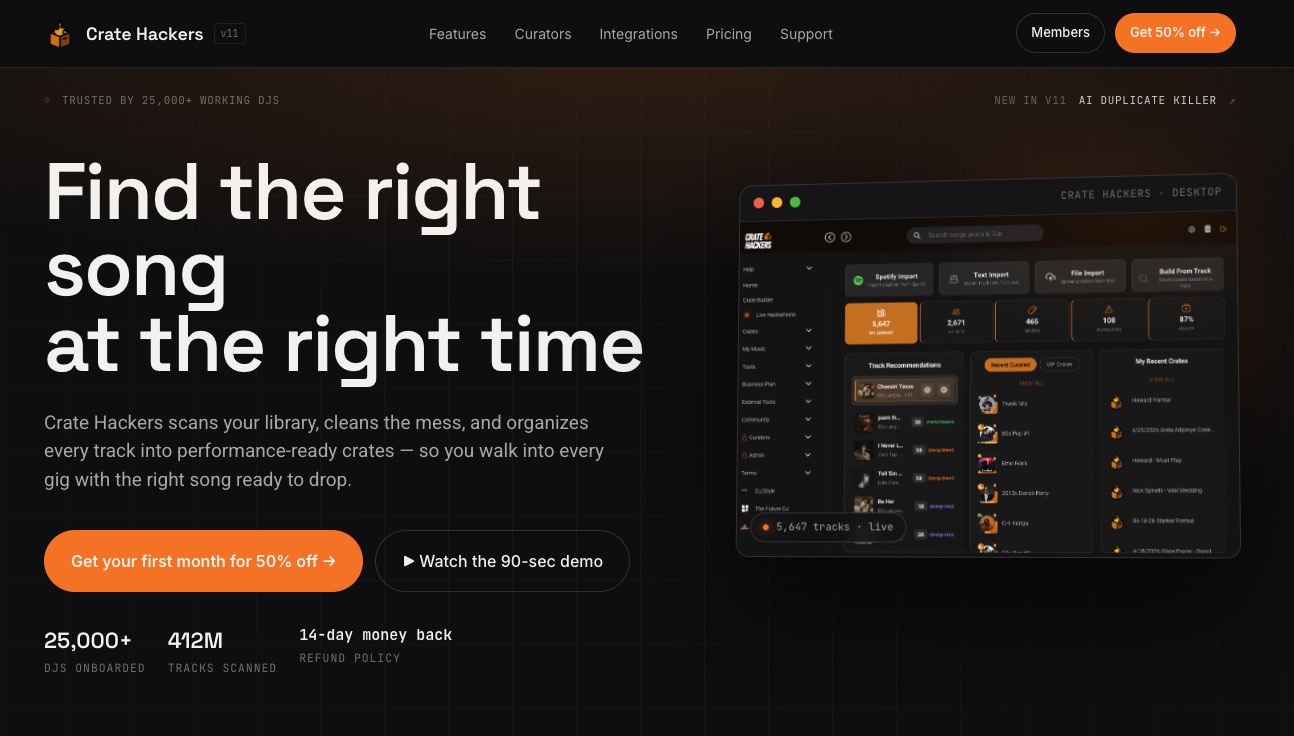
Crate Hackers was built specifically for working DJs who need to organize large libraries, build crates fast, and export clean playlists directly to Serato, Rekordbox, or Virtual DJ without the manual grind. The platform scans your local files, removes duplicates, matches your tracks against streaming playlists from Spotify, Apple Music, and Tidal, and lets you build performance-ready crates in a fraction of the usual time. Whether you’re running the Playlist Pyramid, building energy blocks, or prepping gig-specific sets, Crate Hackers handles the library side so you can focus on the music.
Frequently asked questions
What is the Playlist Pyramid method for DJs?
The Playlist Pyramid is a five-stage filtering system guiding DJs from wide music discovery through shortlisting, purchasing, preparing, and packing a flexible gig playlist.
How many tracks should I pack for a typical DJ set?
Pack roughly double the number of tracks your set actually requires, giving you real-time flexibility to respond to crowd shifts without running dry.
How do energy block playlists improve DJ practice?
Energy block playlists simulate a live gig structure during practice, helping DJs build instinct for transitions between warm-up, peak-time, and cool-down moments.
Why create separate playlists for early doors, peak, and wind down?
Distinct phase playlists let you match energy precisely to where the crowd is in the night, preventing the scramble and dead air that come from using one giant undivided playlist.