
TL;DR:
- Proper library organization by function reduces decision fatigue and enhances live performance confidence.
- Preparing roughly three times the set length and applying energy scoring helps build smooth, adaptable energy arcs.
- Focusing on targeted transition practice and effective software prep allows hobbyist DJs to deliver polished and spontaneous mixes.
You can own the most impressive hobbyist DJ equipment on the market and still blank at the booth. Not because you lack skill. Because you didn’t prepare. Understanding how hobbyist djs improve mix preparation is less about knowing more music and more about building systems that free your brain during the set. Most hobbyist DJs mistakenly believe that spontaneous mixing is the goal. It isn’t. Real spontaneity comes from preparation so solid that your decisions feel effortless. This article breaks down exactly how to build that foundation, step by step, without overcomplicating it.
Table of Contents
- Key takeaways
- How hobbyist DJs improve mix preparation through library organization
- Strategic track selection and energy mapping
- Using DJ software to cut preparation time
- Practice techniques and building flexible sets
- My honest take on how hobbyist DJs prepare
- Let Cratehackers do the heavy lifting
- FAQ
Key takeaways
| Point | Details |
|---|---|
| Library organization is performance | Tagging tracks by function rather than genre cuts decision time and reduces live panic. |
| Prepare 3x your set length | Having more tracks than you need keeps you flexible and confident during any set. |
| Use energy scoring | Assign tracks a score of 1 to 5 and group them so your set flows without jarring jumps. |
| Cue points cut mental load | Setting basic cue points at intros and outros removes guesswork at the worst possible moment. |
| Practice transitions, not full sets | Rehearsing specific tricky transitions builds real confidence without locking you into a rigid plan. |
How hobbyist DJs improve mix preparation through library organization
Most hobbyist DJs think of their music library as storage. It isn’t. It’s your performance engine. And a cluttered unsorted library actively causes decision fatigue and increases live mistakes.
Here’s the mindset shift: stop organizing by genre alone. Genre tells you what a track sounds like. It doesn’t tell you what job it does in a set.
Instead, tag tracks by function. Think in roles:
- Warm-up: Low energy, groovy, builds anticipation without peaking too early
- Groove tool: Mid-energy tracks that keep the floor moving between bigger moments
- Peak-time weapon: Your hardest-hitting, crowd-reading tracks for when energy is highest
- Cool-down: Tracks that ease the energy back without killing the vibe
When you search your library at the booth, you’re not asking “what genre is this?” You’re asking “what do I need right now?” Functional tags answer that question in two seconds instead of two minutes.
Beyond tagging, clean your library ruthlessly. Remove duplicates. Delete low-quality files. Get rid of tracks you’ve never played and never will. A lean, well-labeled library is faster to search, easier to trust, and way less overwhelming under pressure.
Pro Tip: Keep a dedicated crate of 20 to 30 tracks you know inside and out. Call it your “Anchor Crate.” When things get unpredictable at a gig, go there. Familiarity beats novelty every time when the pressure is on.
If you’re using a Windows machine and want a solid starting point for organizing your DJ music, a structured folder and tagging system before you even open your DJ software makes everything downstream faster.
Strategic track selection and energy mapping
Selecting tracks for a set isn’t about picking your favorites. It’s about building a pool that gives you options in every direction.
The professional standard is simple: prepare roughly three times the number of tracks you actually plan to play. Playing a 90-minute set? Build a pool of roughly 270 minutes of music. That ratio gives you room to read the room, skip tracks that don’t fit the moment, and adapt without scrambling.
Set length also changes your selection strategy:
- Short sets (30 to 60 minutes): These are banger territory. You don’t have time to build slowly. High-impact tracks and crowd-recognizable moments should dominate your pool. Every track needs to pull its weight.
- Longer sets (60 minutes and beyond): Now you have room to breathe. Build energy arcs. Plan intentional drops. Include thematic variety and energy drops so the crowd stays engaged across the full duration.
Once you have your pool, apply energy scoring. This is one of the most underused DJ mix preparation tips in the hobbyist space. Here’s the system:
| Energy score | Track feel | Best placement |
|---|---|---|
| 1 | Chill, ambient, minimal | Opening, closing, cool-down moments |
| 2 | Groovy, low-key movement | Early set, post-drop recovery |
| 3 | Steady mid-energy drive | Mid-set momentum builder |
| 4 | Big groove, building tension | Pre-peak, crowd warming |
| 5 | Full peak, maximum energy | Headline moment, climax |
Assign an energy score to every track in your pool, then group them into clusters by score. When you’re building your set flow, you can move through these clusters deliberately rather than guessing. You stop the chaos of jumping from a 5 to a 2 and wondering why the floor cleared.
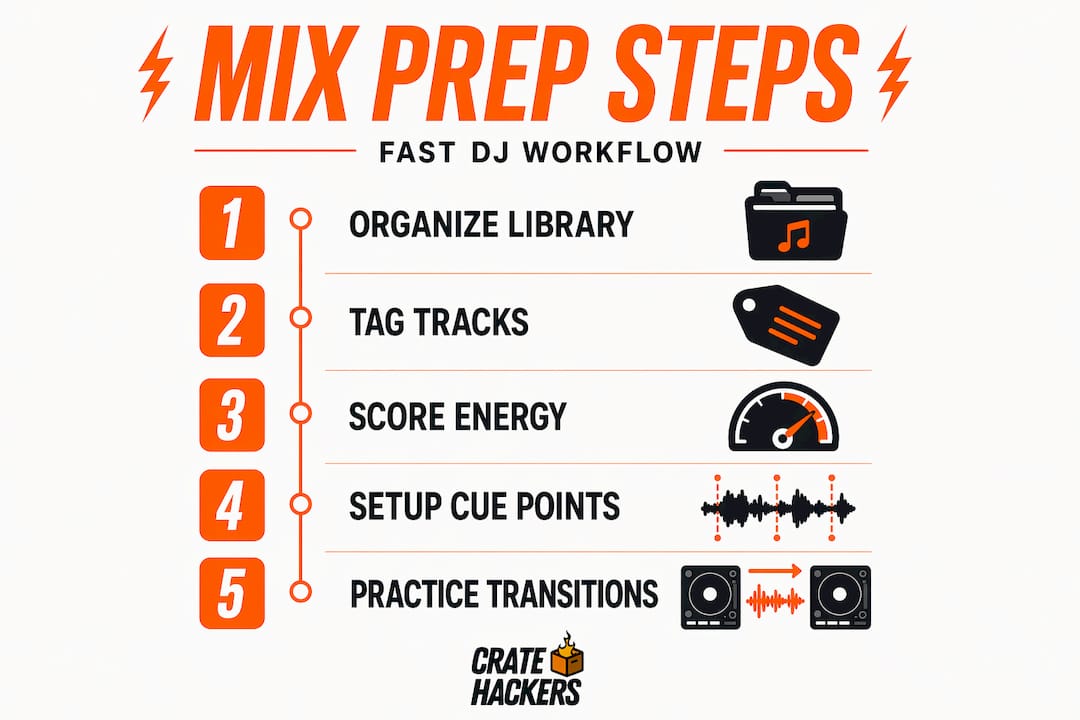
Pro Tip: Avoid climbing more than two energy levels in a single transition. A jump from 2 to 5 is a cliff for the audience. Go 2 to 3 to 4 instead, and the crowd won’t even notice you’re leading them somewhere.
Using DJ software to cut preparation time
Your DJ software is doing a lot of work you might not be using. Most hobbyist DJs use maybe 30% of what their software can do. That’s preparation time left on the table.
Start with analysis tools. Run BPM and key detection on every track before your set. This unlocks harmonic mixing, which means your transitions won’t sound like two songs fighting each other. Mixing in key is one of the most effective mixing techniques for DJs who want their sets to sound polished without years of training.
Cue points are where software preparation really pays off live. The goal is to set basic cue points at intros and outros for every track in your pool. When your next track is already cued to the right spot, you’re not hunting. You’re performing.
Here’s what to prioritize in your software prep:
- Intro cue point: Marks where the track’s main energy begins, so you drop it at exactly the right moment
- Outro cue point: Marks where the track starts losing energy, so you start your mix before the track dies
- Breakdown marker: Useful for longer tracks where you might want to jump past a slow section live
Color-code your cue points. Most DJ software lets you assign colors to different cue markers. Use one color for intros, another for outros, another for breakdowns. At a glance, you see exactly where you are in the track without reading labels.
One critical technical check most hobbyist DJs skip: verify track bitrates before gigs. Bitrates above 2500 kbps can cause tracks to fail loading on CDJs. Catching this at home beats discovering it mid-set.
Finally, build backup USB drives with your full set and test them on actual hardware before the gig. Not your laptop. The real device. What plays fine on your MacBook may behave differently on a venue’s Pioneer setup.
Pro Tip: Check out Cratehackers’ DJ software file reading guide for practical advice on making sure your files are formatted and tagged correctly before they hit your crates.
Practice techniques and building flexible sets
Here’s a counterintuitive truth: rehearsing your full set from start to finish is usually not the best use of your practice time. It feels productive. It isn’t always.
Rehearsing entire sets can actually reduce your adaptability. You get locked into a sequence, and when the crowd throws you a curveball, your brain panics because the script changed. The goal of improving DJ performance isn’t to memorize a setlist. It’s to become confident enough to improvise within a structure.
Instead, practice this way:
- Identify your tricky transitions: Which two tracks in your pool feel awkward to mix? Practice those specific transitions five times until they feel natural.
- Drill core skills in isolation: Spend 15 minutes on beatmatching, 15 on phrasing, 15 on EQ mixing. Targeted practice builds skills faster than full run-throughs.
- Practice reading a “fake room”: Play a track at different energy levels and force yourself to pick the next track that fits. This sharpens your real-time decision-making without the pressure of an audience.
Recording your practice mixes is non-negotiable for DJ skills development. Listening back reveals things you can’t hear in the moment, clumsy transitions, EQ imbalances, pacing issues. Most hobbyist DJs skip this because it feels awkward to hear themselves. That discomfort is exactly why it works.
Set specific goals for each practice session. “Get better at mixing” is too vague to act on. “Practice two key transitions between my 4-energy and 5-energy clusters” is something you can actually do and measure.
Pro Tip: After each practice session, write one thing you did well and one thing to fix next time. Two sentences. It keeps your improvement visible and stops you from repeating the same mistakes on autopilot.
My honest take on how hobbyist DJs prepare
I’ve watched a lot of hobbyist DJs get in their own way. They build enormous libraries with thousands of tracks and feel proud of it. Then they freeze at the booth because there’s too much to choose from. More music is not more preparation. It’s more chaos.
What actually worked for me was simplifying obsessively. I cut my active library down. I tagged everything by function. I stopped trying to prepare the “perfect set” and started preparing a toolkit I could trust in any situation. That shift reduced my pre-gig anxiety more than any piece of hobbyist DJ equipment I ever bought.
Rehearsing specific transitions instead of full sets was another turning point. I used to run through complete sets and feel confident. Then I’d get live, someone would make a request, and the whole mental model would collapse. Spot practice on my problem transitions meant I had real confidence in the moves I needed most.
The hardest lesson was trusting my instincts more. Good preparation isn’t about removing all uncertainty. It’s about giving yourself enough of a foundation that uncertainty stops feeling dangerous. Build your systems incrementally. Learn something from every single set. You don’t need to fix everything at once. You just need to get 1% better each time you play.
— Dominick
Let Cratehackers do the heavy lifting
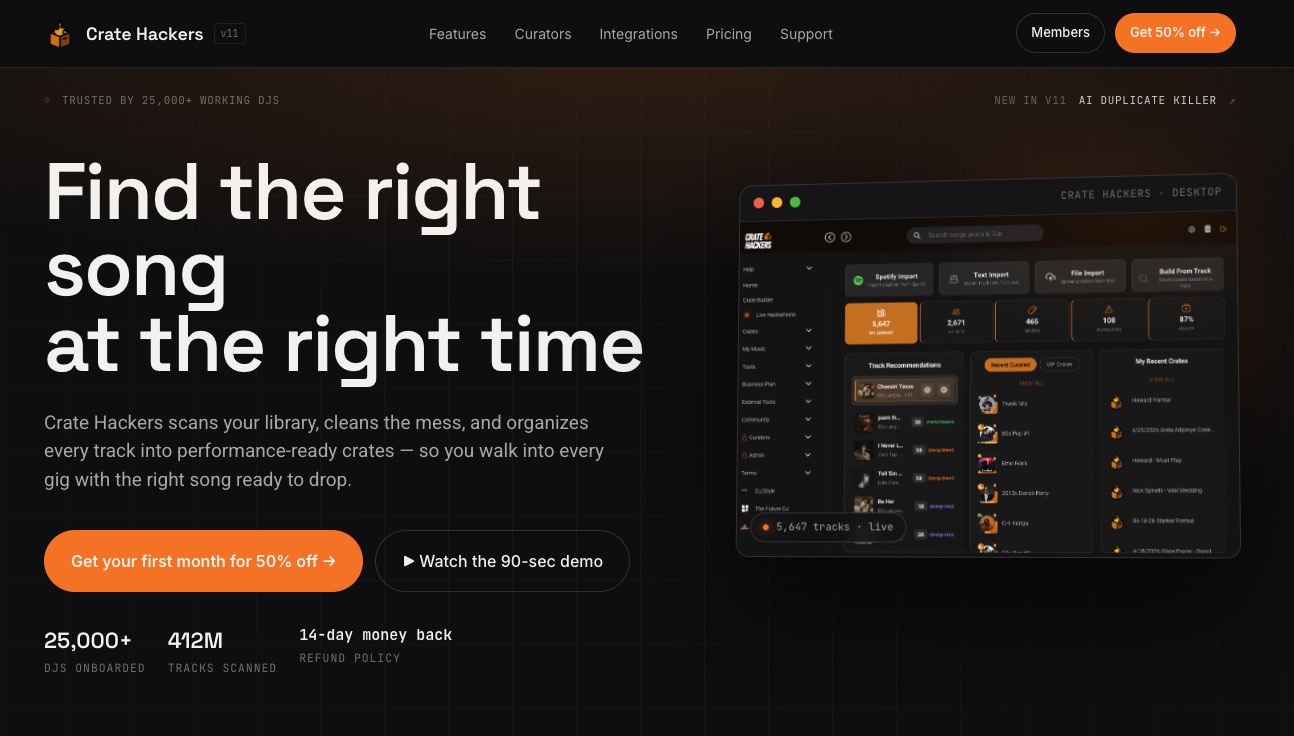
Preparation is only as good as the tools behind it. Cratehackers is built for DJs who want to spend less time digging and more time playing. Whether you’re cleaning up a bloated library, removing duplicates, or building crates organized by energy and function, the platform handles it fast.
Cratehackers works with Serato, Rekordbox, and Virtual DJ. It runs offline on macOS and Windows. It matches your local files to streaming playlists on Spotify, Apple Music, and Tidal so your crates stay current. And its AI-powered Duplicate Killer removes the clutter that makes your library feel overwhelming.
Stop scrolling through thousands of tracks trying to find the right one. Find the right song every single time, with a library that’s actually organized around how you perform.
FAQ
How many tracks should I prepare for a DJ set?
Professionals recommend a 3:1 ratio of available tracks to set length. For a 60-minute set, prepare roughly 180 minutes of music to stay flexible and avoid running out of options.
What is functional tagging in DJ preparation?
Functional tagging means labeling tracks by their role in a set, such as warm-up, groove tool, or peak-time weapon, rather than genre alone. This method speeds up live decisions and reduces booth stress significantly.
Should I rehearse my full DJ set before a gig?
Not necessarily. Practicing specific tricky transitions builds more real-world confidence than memorizing a full set from start to finish. A memorized set can fall apart the moment conditions change.
How do cue points help during a live set?
Cue points pre-marked at track intros and outros remove guesswork under pressure. They let you drop tracks at exactly the right moment without hunting through the waveform while the current track is ending.
What is energy scoring and why does it matter?
Energy scoring means assigning each track a number from 1 to 5 based on its intensity. Grouping tracks by score lets you plan smooth energy arcs and avoid jarring jumps that disconnect audiences from the set.