TL;DR:
- Offline DJ software operates without internet, ensuring reliable performances and consistent cue points. Pre-rendering and local libraries reduce CPU load, prevent mid-set failures, and enhance mix quality. Building an offline library and using export modes provide confidence and stability for professional DJing.
Offline DJ software is defined as any DJ application or hardware workflow that performs without requiring an active internet connection for track loading, login authentication, or real-time processing. The benefits of offline DJ software go beyond simple convenience. They cover CPU stability, version control, hardware freedom, and the kind of mental clarity that lets you focus on the crowd instead of your screen. Tools like Rekordbox, Serato, and Denon DJ Prime 4+ all support offline workflows, and understanding why that matters will change how you prepare for every gig.
1. Benefits of offline DJ software start with zero internet dependency
Offline-first DJ systems allow you to perform entire sets without any internet dependency, meaning zero percent of your show relies on logins, updates, or cloud track loading. That is not a minor detail. Club Wi-Fi is notoriously unreliable, and a dropped connection mid-set is not a technical inconvenience. It is a career moment you do not want.
When your library lives locally and your software runs offline, the venue’s network becomes irrelevant. You walk in, plug in, and play. No buffering. No license checks. No panic.
2. Lower CPU load means fewer crashes on stage
Offline rendering reduces CPU spikes during live DJ performances by separating the heavy processing work from the live playback engine. When your software is not simultaneously streaming, analyzing, and rendering in real time, it has one job: play audio cleanly. That focus matters when you are two hours into a set and the room is packed.
Pre-rendering complex transitions and stem separations at home means your laptop is not sweating through calculations while you are trying to read the crowd. The live engine stays lean. The set stays tight.
Pro Tip: Before any gig, run a full offline playback test of your set at home. If your CPU spikes above 70% during that test, your transitions need to be pre-rendered, not processed live.
3. Offline rendering unlocks mix quality you cannot achieve live
Offline rendering workflows provide repeatability and fine control preferred for podcasts, radio mixes, and professional recordings. Live mixing is reactive. Offline mixing is surgical. You can automate transitions, layer stems, and dial in EQ curves without the pressure of a live audience waiting.
Tools like DJ.Studio are built specifically for this. You build the mix offline, export it clean, and the result is a product that sounds like it was mastered, not improvised. For promo mixes, demo recordings, or radio submissions, that difference is everything.
4. Version control keeps your cue points exactly where you left them
Offline libraries maintain consistent metadata, preventing cue point and version changes mid-set that streaming might cause. If you have ever opened a streaming-linked library and found your hot cues shifted or a track replaced with a remaster, you already know the pain this solves.
With offline files, your edits stay locked. The intro you trimmed, the loop you set at the drop, the custom grid you fixed on that track with a drifting BPM. None of it changes unless you change it. That consistency is what separates a rehearsed set from a gamble.
- Cue points stay fixed across sessions and hardware
- Track edits and custom remixes remain unaffected by cloud sync
- BPM grids you corrected manually do not reset
- Metadata like key, genre, and energy tags stay intact
Consistent offline versions let you maintain personalized cue points, remixes, and track edits without surprises from cloud sync changes. That is not a workflow preference. That is professional insurance.
5. Pre-gig preparation becomes a real rehearsal, not a guess
Offline workflows let you build and test full crates before the gig, not just browse them. You can load every track, check every transition, and confirm every cue point fires correctly. Offline preparation with local files prevents mid-set failures common with streaming dependency.
Think of it as a “Weekend Stress Test.” You simulate the full set at home, offline, with the same USB or library you will use at the venue. If something breaks in your living room, you fix it there. Not at the club at 11 PM.
This kind of preparation also reduces anxiety. When you know your crates load instantly and your transitions are locked, you stop managing software and start managing the room.
6. Standalone hardware and USB export modes eliminate the laptop entirely
Rekordbox export mode enables fully analyzed sets prepared at home and playable via USB without carrying a laptop. You do the work at your desk, export to a drive, and walk into the venue with a thumb drive and confidence.
Hardware like the Denon DJ Prime 4+ runs standalone on pre-prepared USBs, meaning your entire setup is a controller and a drive. No laptop bag. No power adapter hunt. No software update notification appearing at the worst possible moment.
| Setup type | Equipment needed | Internet required | Failure points |
|---|---|---|---|
| Laptop + streaming | Laptop, cables, Wi-Fi | Yes | Wi-Fi, software, licensing |
| Laptop + offline library | Laptop, USB backup | No | Software crash only |
| Standalone hardware + USB | Controller, USB drive | No | Hardware failure only |
Standalone DJ hardware running offline negates the need for a laptop, simplifying setup and improving reliability. Fewer variables means fewer things that can go wrong between load-in and showtime.
7. Offline music organization builds a cleaner, faster library
When your library is offline and local, you control it completely. You can organize DJ music on Windows PC or macOS without worrying about sync conflicts, cloud latency, or subscription access changes affecting your files.
A clean offline library also loads faster. No waiting for metadata to pull from a server. No thumbnails buffering. You type a key, a BPM range, or an energy tag, and the track appears instantly. That speed matters when a song ends and you need the next one in three seconds.
The discipline of managing an offline library also forces better habits. You tag properly because you have to find things yourself. You remove duplicates because they slow down searches. You build crates with intention because there is no algorithm doing it for you.
8. Offline DJ software vs streaming and mobile apps
Streaming DJ setups are vulnerable to Wi-Fi failures, licensing problems, and network-dependent updates that can disrupt a show. Offline software does not have those failure modes. That is not an opinion. It is a structural advantage.
Mobile DJ apps offer portability, but mobile apps sacrifice reliability due to OS updates and multitasking, making offline laptop or hardware the preferred choice for high-stakes events. Your phone getting a background update mid-set is a real risk. Your Rekordbox USB does not update itself.
“The offline library should be the bulletproof standard, with streaming as a secondary fallback to ensure nonstop gigs.” — DJ Pool vs Streaming in Clubs
Here is the honest breakdown:
- Offline software: No internet needed, stable playback, full version control, professional standard
- Streaming apps: Convenient for discovery, risky for performance, dependent on licensing agreements
- Mobile DJ apps: Great for casual use, unreliable for professional or high-stakes events
The advantages of offline music mixing are not about being old-school. They are about removing variables that have nothing to do with your skill as a DJ.
Key takeaways
Offline DJ software is the professional standard because it removes internet dependency, stabilizes CPU performance, and locks in version control so your set plays exactly as prepared.
| Point | Details |
|---|---|
| Zero internet dependency | Offline-first systems let you perform full sets without Wi-Fi, logins, or cloud access. |
| Lower CPU load | Pre-rendering transitions offline keeps the live engine focused on clean audio playback. |
| Version control | Cue points, edits, and metadata stay locked when your library lives locally. |
| USB and standalone freedom | Export modes in Rekordbox and hardware like Denon DJ Prime 4+ eliminate laptop dependency. |
| Streaming is a backup, not a foundation | Offline libraries are the bulletproof standard; streaming should only supplement them. |
Why offline is the only workflow I trust on stage
I have played gigs where the venue’s Wi-Fi went down before the first song. I have seen DJs lose their entire streaming library because a licensing agreement changed overnight. I have watched a mobile app crash during a wedding reception because the phone received a background update.
None of that has ever happened to me with an offline setup. Not once.
The thing most DJs miss is that offline workflows are not just about avoiding failure. They are about building confidence. When you know your crates are locked, your cue points are exactly where you set them, and your USB has been stress-tested at home, you stop thinking about the gear. You start thinking about the crowd. That mental shift is where great sets come from.
I also think the preparation discipline that offline workflows force is underrated. You cannot be lazy with an offline library. You have to tag properly, build crates with intention, and test everything before you walk out the door. That discipline shows up in your sets. Venues notice. Crowds feel it. Repeat bookings follow.
If you are still treating streaming as your primary source and offline as a backup, flip that. Build your offline library first. Make it bulletproof. Then use streaming to discover new music and fill gaps. That is the workflow that holds up under pressure, and pressure is the only condition that matters when you are behind the decks.
— Dominick
Build your offline library with Cratehackers
Your offline workflow is only as strong as the library behind it.
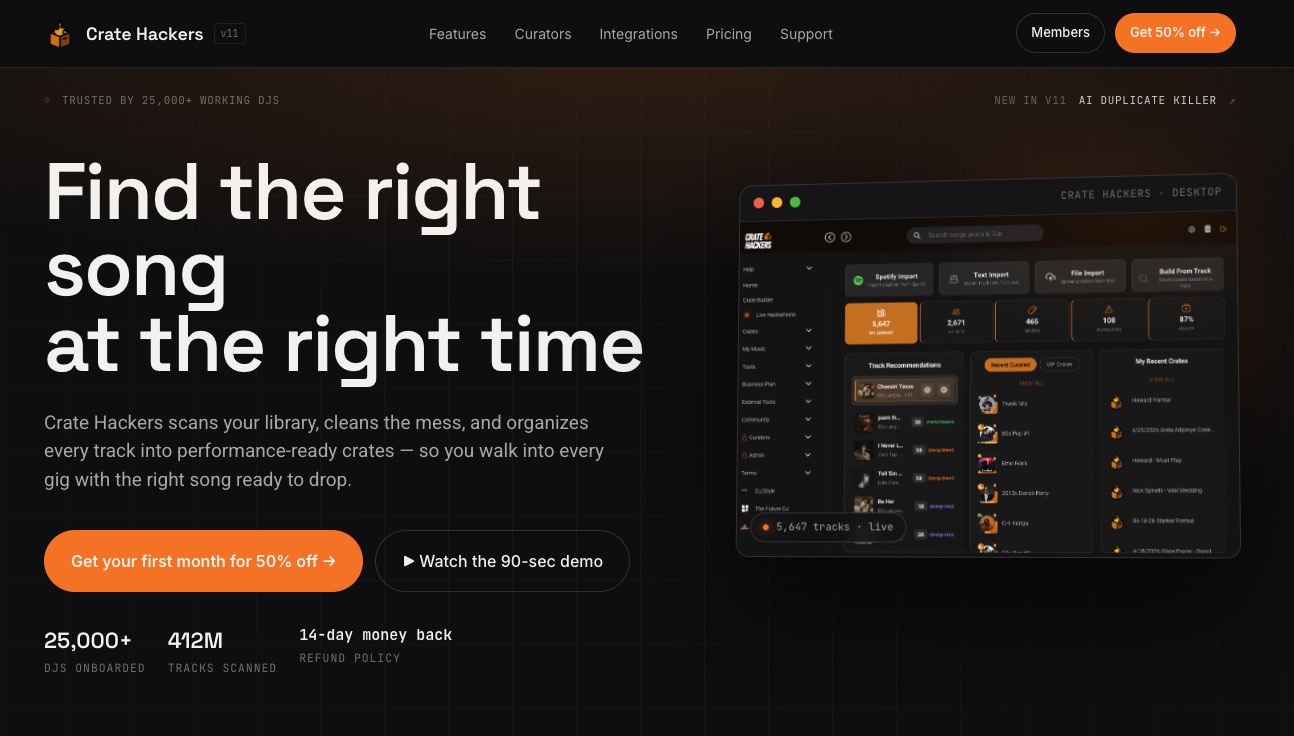
Cratehackers is built specifically for DJs who take preparation seriously. The platform scans your local collection, kills duplicates, and builds performance-ready crates that export directly to Serato, Rekordbox, and Virtual DJ. You can also match your offline files against Spotify, Apple Music, and Tidal playlists to find gaps before the gig, not during it. If you want to read music files like a pro and stop losing tracks in a bloated library, Cratehackers is the tool that makes your offline setup actually work.
FAQ
What is offline DJ software?
Offline DJ software is any DJ application or hardware workflow that operates without an active internet connection for track loading, playback, or authentication. Examples include Rekordbox in export mode, Serato with a local library, and standalone hardware like the Denon DJ Prime 4+.
Why use offline DJ software instead of streaming?
Offline DJ software eliminates the risk of Wi-Fi failures, licensing interruptions, and network latency that streaming setups face. It is the professional standard for reliable, repeatable performance.
Does offline DJ software improve audio quality?
Yes. Offline rendering allows high-resolution processing and detailed transition control that real-time live mixing cannot match, particularly for pre-recorded mixes, radio shows, and professional recordings.
Can you DJ without a laptop using offline software?
Yes. Rekordbox export mode and standalone hardware like the Denon DJ Prime 4+ let you perform full sets from a pre-prepared USB drive, with no laptop required.
How does offline library management reduce prep anxiety?
Offline libraries let you test every cue point, transition, and crate before the gig in a controlled environment. When everything is confirmed locally, you walk into the venue knowing your set is ready.