
TL;DR:
- A DJ drop is a pre-recorded branding audio clip used during sets to reinforce identity and energize transitions. It differs from a musical drop, which is a peak energy moment in a track, serving different purposes in a performance. Using drops strategically and consistently helps build a recognizable brand and maintains crowd engagement.
If you’ve ever heard someone say “the drop” and assumed they meant that explosive moment when a beat kicks back in, you’re not alone. But in the DJ world, a DJ drop means something completely different. Understanding what is a DJ drop in music context is one of those foundational pieces of knowledge that separates DJs who sound professional from those who still sound like they’re figuring it out. This guide breaks down the DJ drop meaning, how it differs from the musical drop, and exactly how you can use drops to sharpen your brand and energize every set.
Table of Contents
- Key takeaways
- What is a DJ drop in music context
- DJ drop vs. musical drop: know the difference
- Types of DJ drops and when to use them
- Best practices for creating and mixing drops
- How DJ drops build your brand and connect with audiences
- My take on mastering DJ drops
- Level up your sets with Cratehackers
- FAQ
Key takeaways
| Point | Details |
|---|---|
| DJ drop vs. music drop | A DJ drop is a branding audio clip. The musical drop is the energy climax of a song. These are completely different things. |
| Core purpose of a DJ drop | DJ drops build your audio identity and create hype at key moments in your set. |
| Types to know | Branding drops, hype drops, and intro drops each serve a specific function during a performance. |
| Timing is everything | Play drops during minimal vocal or instrumental sections to keep clarity and groove intact. |
| Sparing use wins | Overusing drops kills their impact. Strategic placement across your set preserves the punch. |
What is a DJ drop in music context
Let’s get straight to it. A DJ drop is a short pre-recorded audio clip inserted into a set, typically combining a voiceover with sound effects to reinforce your brand and energize transitions. Think of it as your audio stamp. The crowd hears it and they know exactly who’s in control of the room.
A DJ drop is not music. It’s not a song section. It’s a purpose-built audio clip that announces your presence, fires up the energy, or gives your mix a distinct professional identity.
Here’s what goes into a standard DJ drop:
- DJ name or alias: “You’re listening to DJ Marcus, the one and only.”
- Slogan or tagline: A short phrase that represents your brand and style.
- Hype phrases: Short crowd-engaging calls like “Let’s go!” or “Turn it up!”
- Sound effects: Reverb, distortion, pitch shifts, and layers that make the clip feel polished and unique.
- Optional music bed: A short snippet of music played quietly underneath the voiceover.
Drop length varies by style. A “sting” style drop is short and punchy, typically seven words or fewer. A “sweeper” style runs longer, sometimes up to thirty words, and is used for more dramatic intros or set transitions. Both have their place depending on your context and crowd.
Professional drops often use stylized voice effects like reverb, pitch-shifting, and distortion to create a sound that feels bigger than just a voice recording. That sonic texture is part of what makes a drop memorable.
Pro Tip: Record your drops at the highest audio quality you can. A drop that sounds cheap undercuts your entire professional image. Invest in a decent condenser microphone and treat your recording space before you record anything meant for live use.
DJ drop vs. musical drop: know the difference
Here’s where a lot of people get mixed up. The term “drop” in music can refer to two completely different concepts, and confusing them creates real problems when you’re discussing production, performing, or even booking gigs.
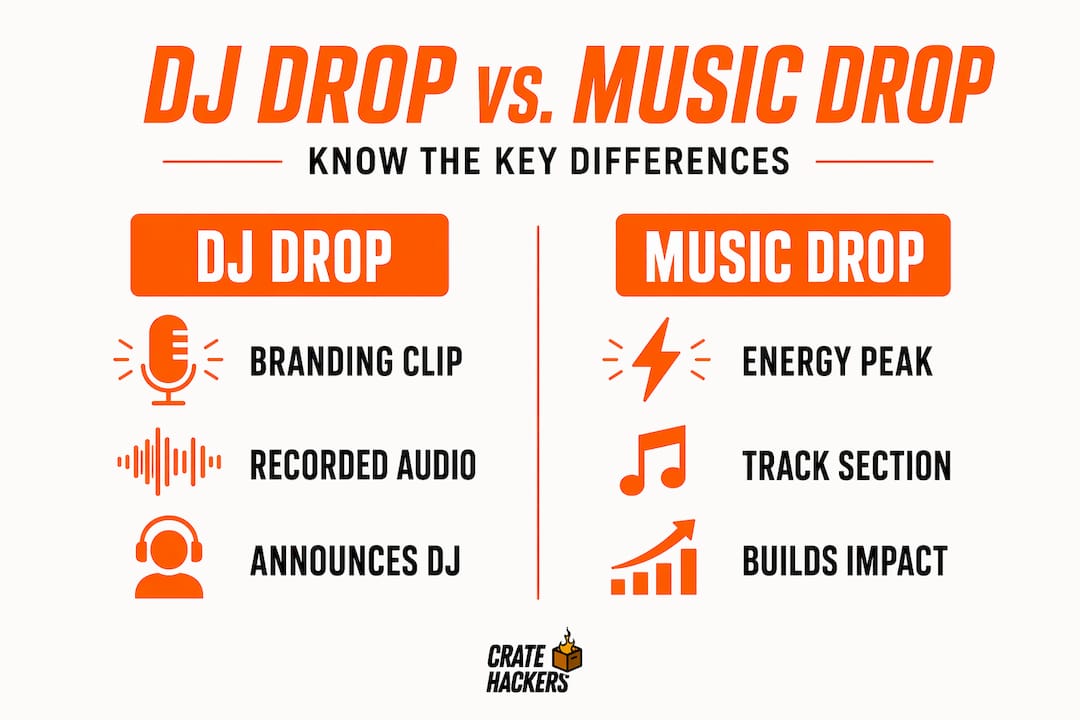
The musical drop is the peak energy moment in a track. It follows a build-up section where tension climbs, and then the full beat and bass slam back in. You hear this constantly in EDM, house, and hip-hop. That moment the crowd loses it? That’s the musical drop.
The DJ drop is a branding clip you play during your set. It has nothing to do with the structure of a song.
Here’s a side-by-side to lock in the distinction:
| Feature | DJ drop | Musical drop |
|---|---|---|
| What it is | Pre-recorded audio branding clip | Section of a song at energy peak |
| Purpose | Branding, hype, identity | Musical tension release and energy climax |
| Created by | The DJ or a voiceover producer | The track’s producer or artist |
| When it plays | Between or over tracks during transitions | Within a song’s structure |
| Length | A few seconds up to 30 seconds | Varies with the track, often 16-32 bars |
| Audience effect | Reinforces DJ identity and hypes the crowd | Creates peak dance floor energy |
Mixing up these two terms in conversation makes you sound like you’re still learning the basics. More critically, confusing these concepts can lead to mismatched expectations during actual performances. Know the difference cold before you step behind any setup.
Types of DJ drops and when to use them
Not all drops do the same job. DJ drops fall into distinct categories depending on what function they serve in your set. Using the right type at the right moment is what separates a calculated DJ from one who just throws things in randomly.
Here are the core types of DJ drops and how each one works:
-
Branding drops: These feature your DJ name, your tagline, or both. You use these to build recognition over time. A well-placed branding drop at the start of your set or during a key transition plants your identity in the crowd’s memory.
-
Hype drops: These are pure energy. Short, aggressive phrases designed to spike crowd excitement. “Everybody on your feet!” or a crowd shout-back cue falls into this category. You drop these when energy needs a kick, not when things are already peaking.
-
Intro drops: These open your set or a major section of your set. Longer, more produced, and more cinematic. They set the tone before the first track even drops.
-
Transition drops: Played between tracks to smooth a genre switch or tempo change. They give the crowd a half-second to reset mentally while keeping the energy from dipping.
-
Event-specific drops: Many professional mobile DJs create drops tailored to specific events. A wedding drop might sound warmer and more personal. A club drop might be harder and more aggressive. Matching the tone to the event is a sign of a DJ who understands their audience. You can see how experienced DJs apply this principle when you look at how they approach booking DJ services for different event types.
Pro Tip: Create at least three different versions of your branding drop. A long version for set openers, a medium version for mid-set transitions, and a short sting for quick placements. Having options means you’re never forcing a drop where it doesn’t fit.
Best practices for creating and mixing drops
Knowing the types of drops is one thing. Knowing exactly how to use them without wrecking your mix is another. Here’s a practical breakdown of how to get this right:
-
Record at professional quality. Use a condenser microphone in a treated room. Thin, echoey recordings sound amateur on a big sound system. Your voice needs to cut through bass, not get swallowed by it.
-
Place drops during instrumental or minimal vocal sections. Playing a drop over a quiet or instrumental moment keeps your message clear. If vocals from the track are fighting your drop, nobody hears either one. The sweet spot is the intro or breakdown of a track.
-
Trigger drops at phrase boundaries. Successful DJs trigger drops at musically safe phrase boundaries with minimal vocals. That means dropping at the start of an 8-bar or 16-bar phrase. Your drop lands like it was composed into the music, not pasted on top of it.
-
Layer with sound effects intentionally. Reverb on your voice helps a drop blend into the mix without sounding disconnected. Avoid over-processing to the point where the words become unclear.
-
Space out your drops across the set. Overusing drops destroys their impact fast. A crowd that hears your drop every two tracks stops registering it. Use it at your opener, a few key transitions, and maybe your big energy peak. That’s it.
-
Export your drops in the correct file format for your DJ software. WAV files at 44.1kHz are the standard. Read up on DJ software file compatibility before loading anything into your setup.
Pro Tip: Organize your drops as their own crate in your DJ software. Label them by type: branding, hype, intro. When you’re performing live and need one fast, you’re not scrolling through your entire library in a panic.
How DJ drops build your brand and connect with audiences
Here’s the truth most DJs miss. A drop is not just a cool production trick. A DJ drop functions as an audio logo, a sonic identity that the crowd starts to associate with your specific sound and presence over time.
Think about how a visual logo works. You see it enough times in the right context and your brain connects it to something. A well-crafted DJ drop does the same thing for your ears. Hear it enough times at great parties and you start connecting that sound to a good time.
The most effective drops share a few qualities:
- Consistency: The voice, the effects, the tone stay the same across all versions of your drop. Changing your drop constantly resets the brand recognition you’ve built.
- Authenticity: Your drop should sound like you. A drop that doesn’t match your DJ persona feels off and crowds pick up on that.
- Production quality: A polished drop signals that you take your craft seriously. It raises your perceived value before a single track plays.
Consider how DJs working in professional wedding and event spaces use drops to position themselves as premium performers. A custom drop that references the event, the couple’s names, or the venue creates a personal moment the audience won’t forget.
Your DJ drop is your audio handshake. The first one sets expectations. Every one after that reinforces your identity. Make sure what you’re reinforcing is something worth remembering.
Think of DJ drops as your audio signature rather than filler. Consistent use over time builds the kind of recognition that keeps you top of mind when clients and fans think about their next event.
My take on mastering DJ drops
I’ve watched a lot of DJs sabotage themselves with drops. Not because their drops were bad, but because their timing was off or they used them like a nervous habit. Every few minutes, another drop. The crowd goes from energized to desensitized in about twenty minutes.
In my experience, the best DJs treat drops like punctuation. You don’t end every sentence with an exclamation mark. You save the big moments for when they count.
I’ve also seen DJs lose the room by dropping a club-hard, aggressive branding clip at a corporate event or a wedding cocktail hour. The drop was well-produced. The timing and context were completely wrong. Know your room before you load your drops.
The other thing I’ve learned is that your drop needs to evolve as you evolve. The tagline that made sense when you were playing high school parties might not fit when you’re headlining club nights. Revisit your drops every year. Ask yourself honestly whether they still represent who you are as a DJ.
Experiment. Customize. But always come back to the question: does this drop serve the set and the crowd, or does it just serve my ego?
— Dominick
Level up your sets with Cratehackers
Building a professional set means more than just great drops. It means having the right tracks ready before you even walk in the door.
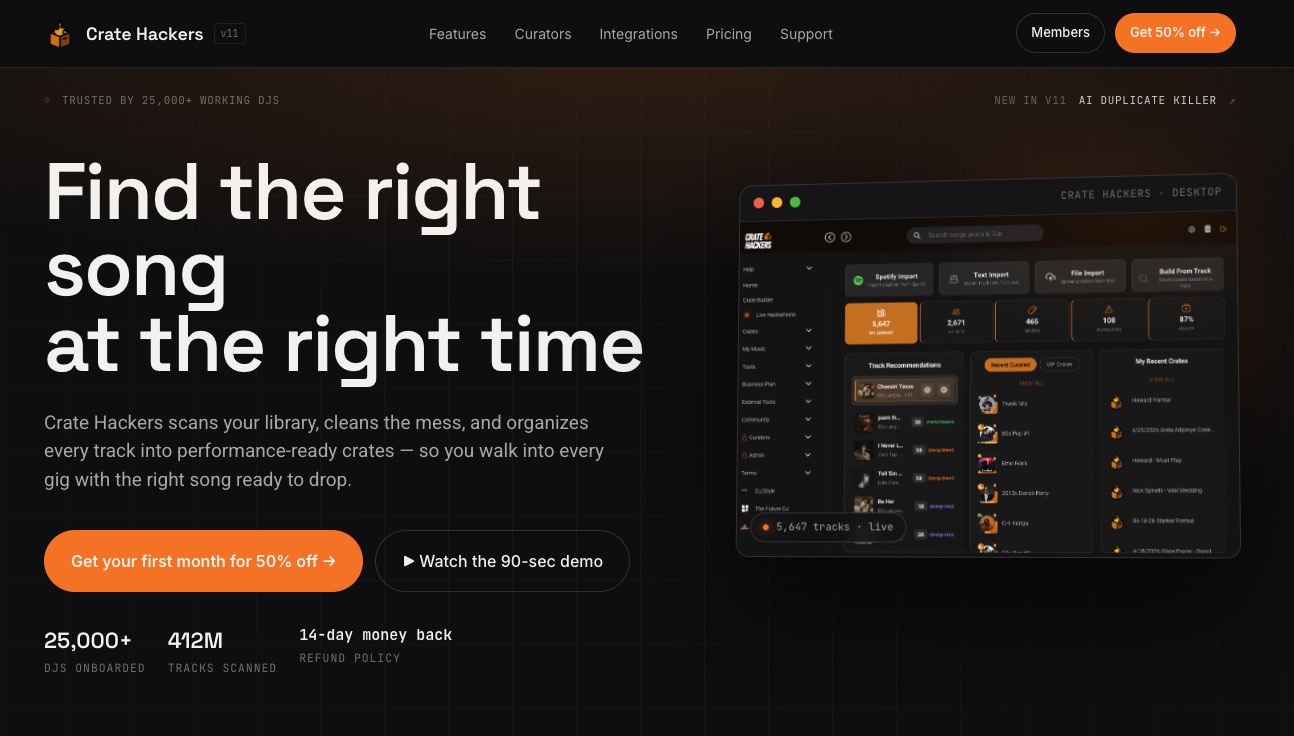
Cratehackers is built for exactly that. It scans and organizes your music library, builds smart crates, removes duplicates, and exports directly to Serato, Rekordbox, and Virtual DJ. No more scrolling through a cluttered library mid-set. No more panic-searching for that perfect transition track. You can also organize your music for every venue type, so your drops and your tracks are always matched to the right environment. Cratehackers puts your whole workflow into one clean, focused system. Your drops handle your brand. Cratehackers handles the rest.
FAQ
What does a DJ drop mean?
A DJ drop is a short pre-recorded audio clip that a DJ plays during a set to announce their name, build hype, or reinforce their brand identity. It typically combines a voiceover with sound effects and lasts anywhere from a few seconds to about fifteen seconds.
How is a DJ drop different from a music drop?
A DJ drop is an audio branding clip created by and for the DJ, while a musical drop is the energy peak section within a track that follows a build-up. They serve completely different purposes and should not be confused with each other.
When should you play a DJ drop in a set?
Play your drop during instrumental sections or moments with minimal vocals so the message stays clear and the music groove stays intact. Triggering drops at the start of a musical phrase makes them sound like a natural part of the mix.
How often should you use a DJ drop?
Use drops sparingly. Strategic spacing, such as at your set opener and a few select transitions, preserves the impact. Overusing drops causes the crowd to tune them out and weakens your branding effect over time.
What are the main types of DJ drops?
The main types are branding drops featuring your DJ name, hype drops designed to boost crowd energy, intro drops that open your set, and transition drops that smooth genre or tempo shifts within your performance.